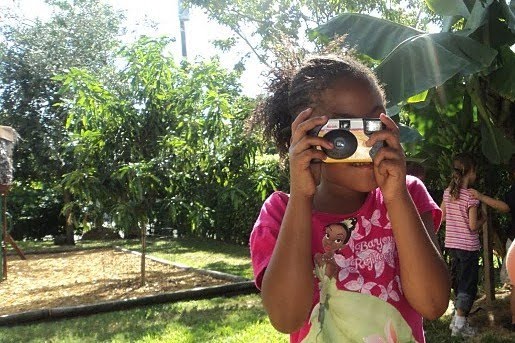
Looking Through the Viewfinder

Looking Through the Viewfinder
"I'm looking through the viewfinder...I see you in mine! Do you see me Ms Hartings?"

Saturday, March 5, 2011

The Joy of Presenting to an Authentic Audience- YouthCAN Challenge at Fairchild Botanical Gardens

On February 17th, my class, the 1st and 2nd graders of La Scuola in Miami, participated in the YouthCAN Challenge at Fairchild Botanical Gardens. "YouthCAN, a youth run organization, unites environmentally active youth to exchange ideas about the environment and empower others to make a difference in their own communities. This conference is a unique opportunity for students to meet and share their ideas and projects about environmental issues and conservation." (YouthCAN Flyer 2011) Every student that participated was engaged in a variety of hands-on activities as they presented and listened to other presentations from their peers. We were the youngest class to represent a school at Fairchild this year, however, besides the fact they are mini sized, you wouldn't have guessed they were the least experienced based on their ability to present the information they feel passionate about with poise and confidence.

The day brought tears to my eyes because I saw this as a first step among many my students will take to reach out into their community and create change and excitement through expressing their interests, concerns, and vision for a better future both within our community and world. When Louise and Ashley Cadwell lead a workshop at our school, they asked our staff to write a few words about our dream for La Scuola. The idea of seeking out authentic audiences for our children feels absolutely vital to the work we are trying to do within my class and as a school. As we think about sustainability, we are always trying to consider how our actions and words can have a tremendous effect on the way others in our community and world will do things concerning taking care of our earth AND each other. Also, the valuable resources available in our community are there, just waiting for us to discover them, bring them back to our home to share, make meaning of, and create personal connections to through exploration, questioning and the 100 other ways children learn and make sense of the world. Finding authentic audiences for my children to share their strong, capable, passionate selves with the community is my dream for our children, and this experience was a precious first step toward achieving it.

Please let me know if you are aware of other opportunities in or outside of Miami for our children to share. We are excited and ready to step up to many other challenges.

The project itself grew out of our larger overarching question “What is Water?” The question was born out of watching and listening to the children talk, read, and create work related to water. Water is very much a part of the identity of Miami. It makes up our ocean, flows through the Everglades, and we experience VERY wet seasons, and extreme draughts as well. Children's interest in water grew organically, and we have explored the many questions that fall under the larger question throughout the year. The idea of water conservation, which turned out to be the heart of the project the children presented at YouthCAN, was sparked by spending time in the school garden and feeding the plants with rainwater caught from our rainy season. The children became interested in measuring the rainfall and keeping track of how much rain was being caught each day. In addition to measuring rainfall, the children became excited about the idea of measuring the amount of water we were using as a class each day by tracking how many times we flushed the toilet, showered, took a bath, and ran the sink. This was measured in gallons and the children were able to visualize the amount by using milk gallons.

After finding out they were each averaging about 50 gallons a day and we were not catching a single drop of water of rain day after day, the children made the connection that we were using a lot of water, but we were not catching natural rain water because we are in the dry season and experiencing a drought. The children expressed interest in creating more rain barrels to catch additional water during the wet season "so we would not run out of natural rain water when the dry season comes again" They also made a pact to take less baths and shorter showers, turn the sink off while they were brushing their teeth, and share this information with their peers, family members, and community.

Next, the children began designing beautiful rain barrels. In conjunction with their rain barrel designs, they also planned to start another garden so we could enjoy the beautiful plants that benefit from the rain we catch. Throughout the process the children learned countless 21st century skills as well as everyday skills that are important to a child’s 1st and 2nd grade year of school. Among these skills were measuring in inches, centimeters, feet, cups, ounces, and gallons; perimeter and area, researching, effective communication skills, collaboration skills, presentation skills, persuasive writing, and many more.

I am unbelievably proud of my class, and I am confident this is just the tip of the iceberg for them. We hope to face many more challenges and think critically about what we can do to contribute to our community positively.


Friday, January 28, 2011

Cooperative Learning

Measuring the perimeter of our garden


Designing garden cinderblocks- creating our own raised garden beds


Painting a class mural based on three designs created by the students and inspired by "The Great Wave" by Katsushika Hokusai
As a teacher, I feel that most children learn best socially. Sure, some tasks call for the student to work independently with absolute concentration to every detail, but the experiences children have during their school years while working as a team to achieve a common goal are some of the most meaningful in my eyes. Most children seem to feel the same way as I watch and listen to them in action with a small group. The laughter, dialogue, excitement that is present most of the time is such a joy to watch. The times that are well...not so joyful, often turn out to be wonderful learning experiences and growth opportunities for the whole group. During these times of observation I often feel I am gathering the most information about the children's interests and their abilities. 

Cooperative learning opportunities pop up everywhere throughout the day. The way we enter into projects as a class; jotting down thoughts and ideas, creating a plan, and engaging in dialogue with each other regarding our ideas and learning goals is a model for the children. I believe the time we spend together as a whole group planning for these experience is extremely important because we are creating an example for the way we want children to interact with one another when they are on their own with peers.

I spend a lot of time every single day reflecting on dialogue we have during Morning Meetings and mini lessons throughout the day. I am very critical of myself when it comes to how much I interject and redirect conversation so that we can be most productive. This is a constant process for me, and although I feel I have grown tremendously when it comes to facilitating, I am a work in process. However, when I see children taking turns talking, being respectful and welcoming when others present new ideas, and sharing a huge piece of work among their group in a fair way so that all members of the group feel equally challenged and important, I am filled up to the brim with joy. This is by far the most important skill a child can learn throughout their school years- how to work together with their peers in a respectful way.
"Save the Earth" student led impromptu chant :)

Wednesday, January 26, 2011

The Writing Process

On Monday, January 24th, the children worked on personal narratives describing a meaningful experience they have had with water. Some chose to write about a time they played in the rain, swimming with family members, or being stuck inside because of bad weather. The children illustrated detailed pictures of this "snapshot" of their life before writing. One of the children stood in front of a mirror to help him compose an accurate drawing of his body. After drawing, they moved through the steps of The Writing Process. Almost all of the children chose to publish their writing after peer editing and revising. They are extremely proud of the hard work they put into their writing, and they had a great time reliving meaningful experiences throughout the process.


Saturday, January 22, 2011

The Eyes of a Child

I believe this quote will speak to you even if you are not one of the lucky ones who work with young children.

“Often in our work, and in our lives, we tend to look for confirmation of what we think and what we believe. We identify ours selves with our ideas and our theories. To change our minds, to reconsider our basic theories and beliefs so as to see their limitations, is often perceived as a personal defeat. Often the ensuing crisis is experienced as a loss rather than as the beginning of something new. The fact is that we are too firmly attached to our theories and to our ideas and thus we often close the door to new ways of seeing and understanding. But new ideas spring forth everywhere, particularly if we live among children. The children themselves stand for what is new for us and what is asking for acceptance. We can never predict the way in which the new will appear, but often it has the eyes of a child. We must, therefore, expect the new to appear, help it come forth, follow it, and nurture it.”

 ~Carlina Rinaldi from Louise Boyd Cadwell’s book The Reggio Approach to Early Childhood Education- Bringing Learning to Life

Reggio Emilia Philosophy

I am writing this post because it has been brought to my attention that not all of my friends have background knowledge about Reggio Emilia. I am sorry for not sharing right away.  I certainly don't want anyone to have to go googling to find out. I will share with you what I know, and then you can go from there. I can say that in Reggio Emilia, Italy, they do not usually practice this approach past Kindergarten. However, I can assure you that the core principals are quite valuable for children of all ages. This philosophy paired with Sustainability Education is a great match. To read up on Sustainability Education go to the Cadwell's website www.cadwellcollaborative.com. I am absorbing all of the information at the moment and I am finding it fascinating and exciting. I hope you can find this information interesting.

Reggio Emilia Philosophy

Piazza - Diana School, Reggio Emilia, Italy

These pictures are from Reggio children's "Open Window" series, they were scanned from slides and posted by a fellow blogger


The following overview of the Reggio Emilia Approach was taken from a packet of information available at The Hundred Languages of Children traveling exhibit:
Hailed as an exemplary model of early childhood education (Newsweek, 1991), the Reggio Emilia approach to education is committed to the creation of conditions for learning that will enhance and facilitate children's construction of "his or her own powers of thinking through the synthesis of all the expressive, communicative and cognitive languages" (Edwards and Forman, 1993). The Reggio Emilia approach to early childhood education is a city-run and sponsored system designed for all children from birth through six years of age. The Reggio Emilia approach can be viewed as a resource and inspiration to help educators, parents, and children as they work together to further develop their own educational programs. The Reggio Emilia approach is based upon the following principles:

Emergent Curriculum: An emergent curriculum is one that builds upon the interests of children. Topics for study are captured from the talk of children, through community or family events, as well as the known interests of children (puddles, shadow, dinosaurs, etc.). Team planning is an essential component of the emergent curriculum. Teachers work together to formulate hypotheses about the possible directions of a project, the materials needed, and possible parent and/or community support and involvement.

Project Work: Projects, also emergent, are in-depth studies of concepts, ideas, and interests, which arise within the group. Considered as an adventure, projects may last one week or could continue throughout the school year. Throughout a project, teachers help children make decisions about the direction of study, the ways in which the group will research the topic, the representational medium that will demonstrate and showcase the topic and the selection of materials needed to represent the work. Long-term projects or progettazione, enhance lifelong learning.

Representational Development: Consistent with Howard Gardner's notion of schooling for multiple intelligences, the Reggio Emilia approach calls for the integration of the graphic arts as tools for cognitive, linguistic, and social development. Presentation of concepts and hypotheses in multiple forms of representation -- print, art, construction, drama, music, puppetry, and shadow play -- are viewed as essential to children's understanding of experience. Children have 100 languages, multiple symbolic languages.

Collaboration: Collaborative group work, both large and small, is considered valuable and necessary to advance cognitive development. Children are encouraged to dialogue, critique, compare, negotiate, hypothesize, and problem solve through group work. Within the Reggio Emilia approach multiple perspectives promote both a sense of group membership and the uniqueness of self. There high emphasis on the collaboration among home-school-community to support the learning of the child.

Teachers as Researchers: The teacher's role within the Reggio Emilia approach is complex. Working as co-teachers, the role of the teacher is first and foremost to be that of a learner alongside the children. The teacher is a teacher-researcher, a resource and guide as she/he lends expertise to children (Edwards, 1993). Within such a teacher-researcher role, educators carefully listen, observe, and document children's work and the growth of community in their classroom and are to provoke, co-construct, and stimulate thinking, and children's collaboration with peers. Teachers are committed to reflection about their own teaching and learning.

Documentation: Similar to the portfolio approach, documentation of children's work in progress is viewed as an important tool in the learning process for children, teachers, and parents. Pictures of children engaged in experiences, their words as they discuss what they are doing, feeling and thinking, and the children's interpretation of experience through the visual media are displayed as a graphic presentation of the dynamics of learning. Documentation is used as assessment and advocacy.

Environment: Within the Reggio Emilia schools, great attention is given to the look and feel of the classroom. Environment is considered the "third teacher." Teachers carefully organize space for small and large group projects and small intimate spaces for one, two or three children. Documentation of children's work, plants, and collections that children have made from former outings are displayed both at the children's and adult eye level. Common space available to all children in the school includes dramatic play areas and worktables for children from different classrooms to come together.
Features of The Reggio Emilia Approach

Teacher Role:
to co-explore the learning experience with the children
to provoke ideas, problem solving, and conflict
to take ideas from the children and return them for further exploration
to organize the classroom and materials to be aesthetically pleasing
to organize materials to help children make thoughtful decisions about the media
to document children's progress: visual, videotape, tape recording, portfolios
to help children see the connections in learning and experiences
to help children express their knowledge through representational work
to form a "collective" among other teachers and parents
to have a dialogue about the projects with parents and other teachers
to foster the connection between home, school and community

Projects:can emerge from children's ideas and/or interests
can be provoked by teachers
can be introduced by teachers knowing what is of interest to children: shadows, puddles, tall buildings, construction sites, nature, etc.
should be long enough to develop over time, to discuss new ideas, to negotiate over, to induce conflicts, to revisit, to see progress, to see movement of ideas
should be concrete, personal from real experiences, important to children, should be "large" enough for diversity of ideas and rich in interpretive/representational expression

Media:explore first: what is this material, what does it do, before what can I do with the material
should have variation in color, texture, pattern: help children "see" the colors, tones, hues; help children "feel" the texture, the similarities and differences
should be presented in an artistic manner--it too should be aesthetically pleasing to look at--it should invite you to touch, admire, inspire
should be revisited throughout many projects to help children see the possibilities


SPACE! Our Beautiful, Bright, Open, Lovely Space...

Reflection on Documentation and Curriculum Mapping with The Cadwell Collaborative

Today is the first rainy, gloomy Saturday I have experienced here in Florida in a few weeks. It has been beautiful here, and I have been enjoying the sunshine and active lifestyle. However, having a cold and being stuck inside has given me the opportunity to begin the blog I have been wanting to start since I began my progressive education journey. I know it will be nice to have a record of my reflections, and I hope to bounce ideas off of like minded educators through blogging.

This week was FULL of reflecting, reading, and thinking. My colleagues and I had the incredible opportunity to meet and have meaningful dialogue with two individuals who dedicate their life to teaching others about their interpretation of the Reggio Emilia Approach and  Sustainability Education, Ashley and Louise Cadwell. They find the beauty in overlapping the two approaches and acknowledging that both approaches seek to empower our children while guiding them in developing 21st century skills. Here is a link to their website. It is definitely a must if you are interested in this type of work. http://cadwellcollaborative.com/

After meeting with the Cadwells, I was inspired and I felt unbelievably refreshed! I took the time to rethink my documentation walls and curriculum map. It became very clear that the web of ideas, questions, academic skills, and 21st century skills that could and should be explored in a project titled "What is Water?" were being overlooked on my part. In fact after looking back on conversations and questions my children had been asking during Morning Meetings, I found the children were practically begging me to go deeper. For whatever reason I had become caught up in moving foward with the New Year, and my listening skills had gone a bit haywire over the holidays (you know we all do it around those certain family members..JUST KIDDING MOM!). Anyway, I took a step back and started restructuring my documentation wall to give myself and more importantly the children a clear idea of the specific questions we were devling into next. Before the PD we thought our walls were beautiful like a gallery space should be, but they were lacking clarity and direction. Ashley mentioned we should think of creating posters, big ones, for the main ideas and themes. In fact, we should be thinking like graphic designers, creating clean lines that apeal to all eyes. The quotations should be in bold and BIG, as well as the questions. They should be seen from across the room.

So, the next day I got to work and I loved every minute. I took down some of the beautiful work we had been collecting gallery style on the walls, and I placed them in a folder to be created into a professional looking book both the children and parents could enjoy daily. I made our question big, and created just a few sub questions to redirect our focus. I feel great about our progress and I am looking forward to exploring with the children!